What Is It?
When athletes talk about strength and conditioning, they usually mean some sort of resistance training combined with mobility work, cardiovascular capacity and plyometrics. A program usually draws on all three of the following.
Resistance
Moving load, with or without equipment
- Barbell lifting
- Dumbbells
- Calisthenics
- Pilates
- Bodyweight circuits
Conditioning
Lung and heart capacity, off the track
- Rower intervals
- Bike efforts
- Hill repeats
- Mobility work
Plyometrics
Explosive movement, safe for older athletes
- Bounding
- Skipping
- Depth jumps
- Med ball slams
Explosive movements such as bounding, skipping, depth jumps and medicine ball slams are effective and safe for older adults when they are programmed properly1.
Good programs are programmed2, meaning they are progressive and cyclic:
- Progressive: intensity and the load on the body increase over time, by adding weight, adding repetitions, or making the movement more challenging.
- Cyclic or periodised: you cannot train maximum weight and volume all the time. Training usually builds across several weeks or months towards a goal, then resets to introduce new stimulus and leave space for competitions.
- Evidence based: programming is informed by well conducted research, supported in the literature and by recognised industry bodies.
- Recovery: the body needs time to recover and adapt to training stimulus. That means rest days during the week, and lighter "deload" weeks scheduled into a training cycle.
Why Should I Do It?
- To be a better athlete: run faster, jump higher, throw further3-5.
- To live better: these programs improve measures strongly associated with living longer and reduction of chronic disease6,7. You will move and breathe more easily.
- Body composition: building on your athletic training, strength and conditioning increases muscle mass8 and reduces central adiposity9,10 (belly fat and the visceral fat around organs). Heavy lifting improves spinal bone density in women11.
- To avoid injuries: it will not make you bullet proof, but a strong base helps protect the body from maximum effort sport12,13.
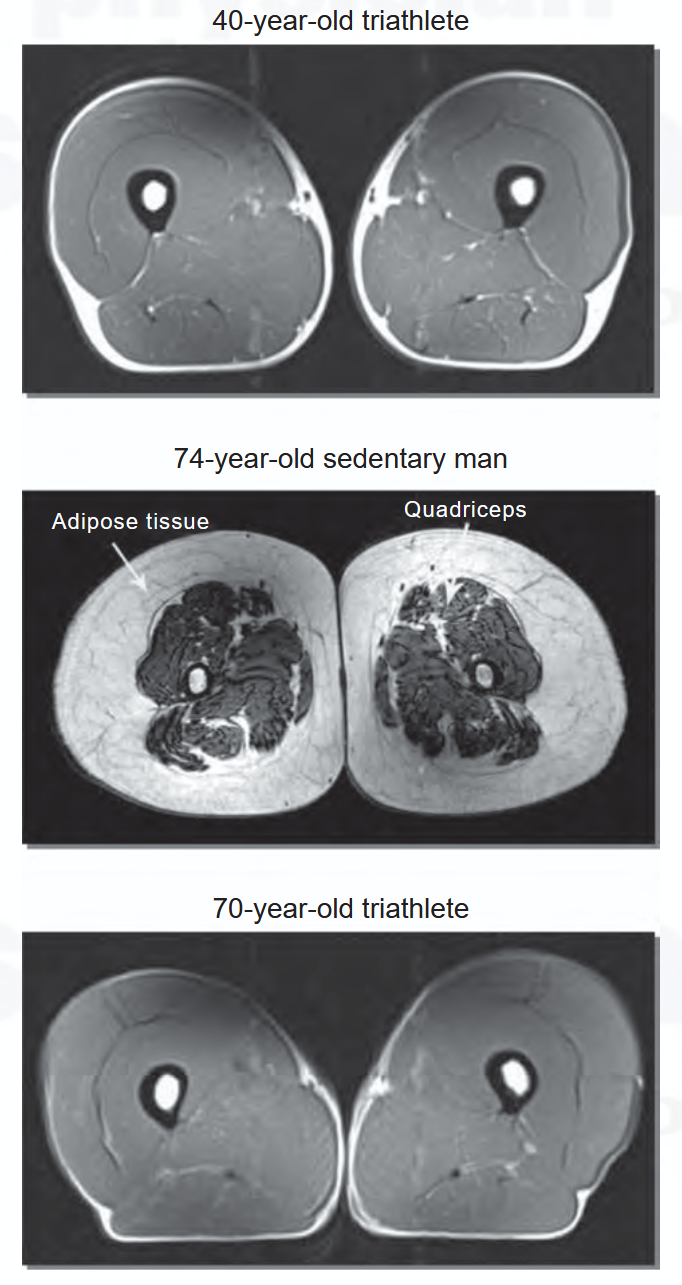
Thigh MRI scans from Wroblewski et al
The dark tissue is muscle and the pale tissue around it is fat. The first image is a cross section scan from an active 40-year-old. The middle image is of inactive man, the muscle appears diminished and the fat layer thickened. In the lower image, we have a 70 year-old active triathlete, thirty years older than the person in the top image. The muscle to fat ratio appears remarkably similar between the two athletes.
The study suggests chronic exercise, not age alone, accounted for most of the body composition difference between active and non-active older people.
Figure reproduced from Wroblewski AP, Amati F, Smiley MA, Goodpaster B, Wright V. Chronic exercise preserves lean muscle mass in masters athletes. Phys Sportsmed. 2011;39(3):172-178.
How Does It Fit Around Athletics And The Rest Of My Life?
Improvements can be found with a minimal amount of work. If we can fit in one or two purposeful sessions a week, most of us will see improved performance and changes in body composition14,15.
When adding to a track and field athlete's schedule, check with your coach, but the general advice is to avoid explosive athletic work on fatigued muscles and tendons. Avoid sprints, throws or a jump session immediately after heavy resistance training. If you are doing both types of training on the same day, put the fast work first and leave two to six hours before doing heavy weights. Be careful with high-speed track work the day after a heavy leg session at the gym16.